Concrete Grinding & Surface Prep for Epoxy Floors
The coating is only as good as the concrete under it. Every floor we coat in the Sacramento area is diamond ground, cleaned and repaired before the first coat goes down.
Epoxy Bonds to What It Can Grab
Troweled concrete has a smooth, dense top layer called laitance, and most garage and shop floors also carry years of oil, tire residue, sealers or old paint. Epoxy rolled over that surface sits on top of it instead of locking into the slab. That’s why coatings peel, flake at the edges, and lift under hot tires.
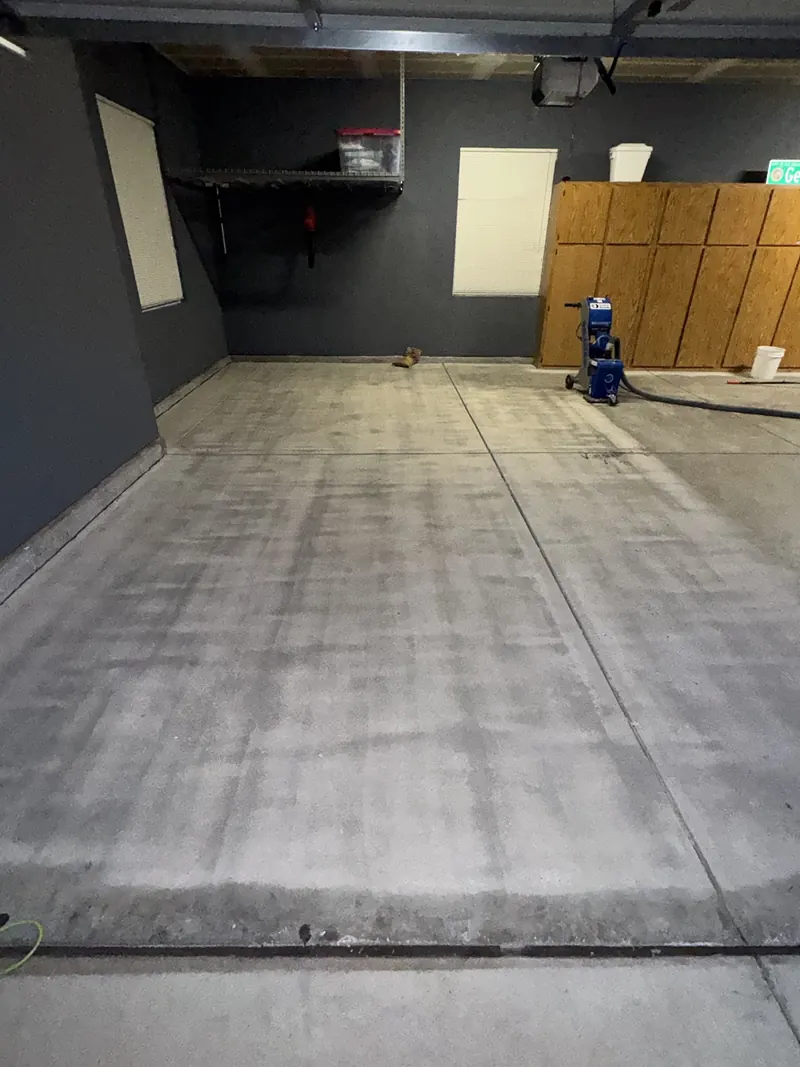
Surface prep fixes this in two ways. It cleans the slab, and it gives the concrete a texture, called a profile, that the coating can mechanically grip.
The industry standard: concrete roughness is measured on the ICRI Concrete Surface Profile (CSP) scale, from CSP 1 (nearly smooth) to CSP 9 (very rough). Most epoxy floor systems call for roughly CSP 2–3, about the feel of medium sandpaper. Diamond grinding gets there consistently.
Diamond Grinding vs. Acid Etching
Both are called “etching,” and both are meant to open the concrete. They don’t perform the same.
| Diamond Grinding (what we do) | Acid Etching | |
|---|---|---|
| How it works | Diamond tooling cuts the top layer off the slab | Acid dissolves part of the surface paste |
| Profile | Consistent and controllable across the whole floor | Uneven, depending on the slab and how it was applied |
| Old coatings & sealers | Removes them | Won’t remove coatings, sealers, glues or mastics |
| Residue | Dry dust, captured by the vacuum extractor | Acid and slurry that have to be fully neutralized and rinsed |
| Moisture added | None | Soaks the slab, which then has to dry completely |
What Prep Looks Like on Our Jobs
Assess the Slab
Check for cracks, spalls, old coatings, oil saturation and signs of moisture coming through the concrete.
Treat Contamination
Remove and treat oil and grease so they don’t keep bleeding into the new coating.
Diamond Grind
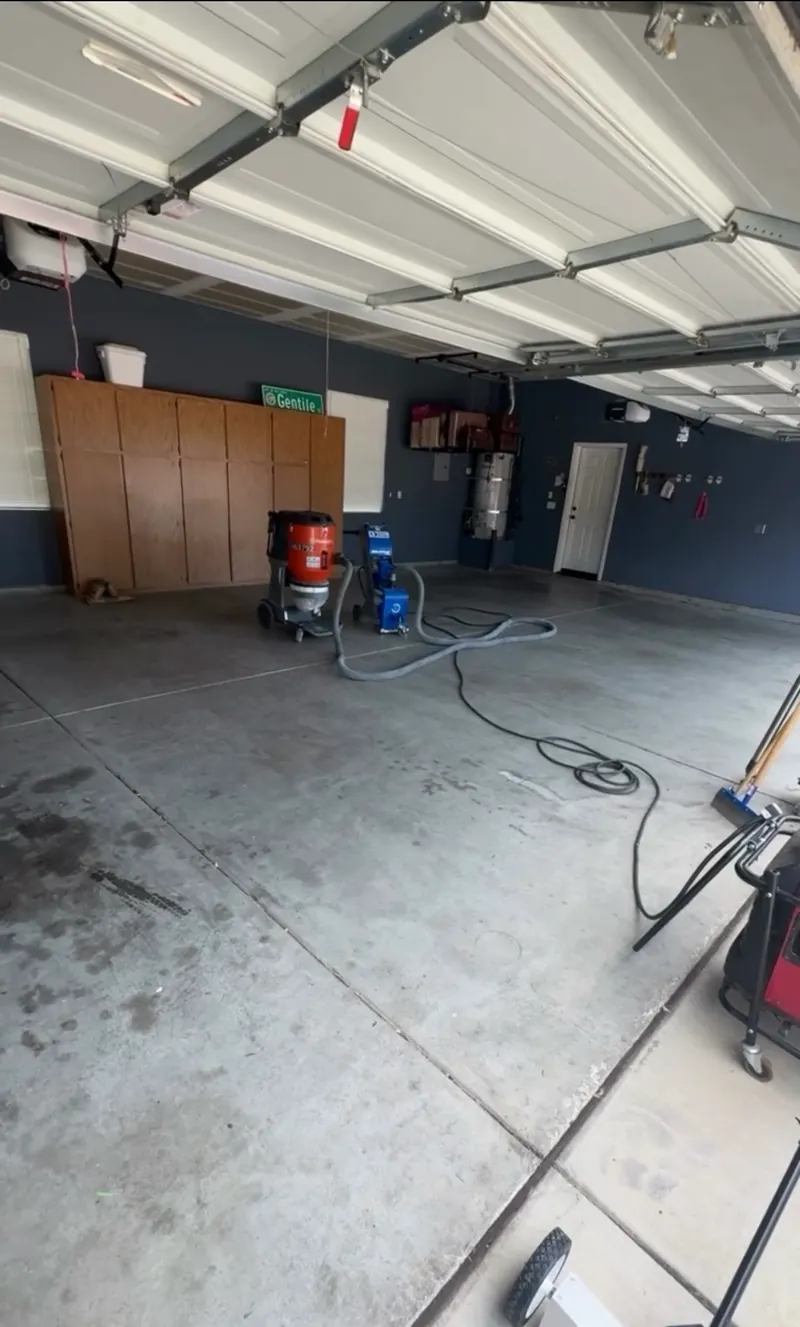
Walk-behind diamond grinder over the whole floor, with edges handled so the profile is even wall to wall.
Repair
Fill cracks, pits and spalls, and address joints for the system being installed.
Vacuum & Inspect
Vacuum the slab clean and check it before the first coat goes down.
Surface Prep Questions
Is diamond grinding the same as concrete etching?
Both open up the concrete surface so a coating can bond. Acid etching does it chemically. Diamond grinding does it mechanically, which is why people sometimes call it mechanical etching. Grinding gives a more consistent profile, removes old coatings and sealers, and doesn’t leave acid residue on the slab.
How much dust does grinding make?
Our grinder runs connected to a vacuum dust extractor that pulls dust off the floor as the grinder cuts. There’s still some cleanup, but most of the dust is captured at the source.
Can you grind off an old peeling coating?
Yes. Failing epoxy, paint and sealers are ground off down to sound concrete. Coating over a peeling floor only buries the problem.
Do all cracks need to be repaired?
Cracks, pits and spalls are filled before coating so they don’t telegraph through the finish. Control joints are handled based on the slab and the system. We’ll go over the options during the walk-through.
Ready to coat? See our garage floors, commercial flooring and coating systems.

Start With the Slab
Not sure what shape your concrete is in? We’ll look at it, tell you what it needs, and put it in writing.